
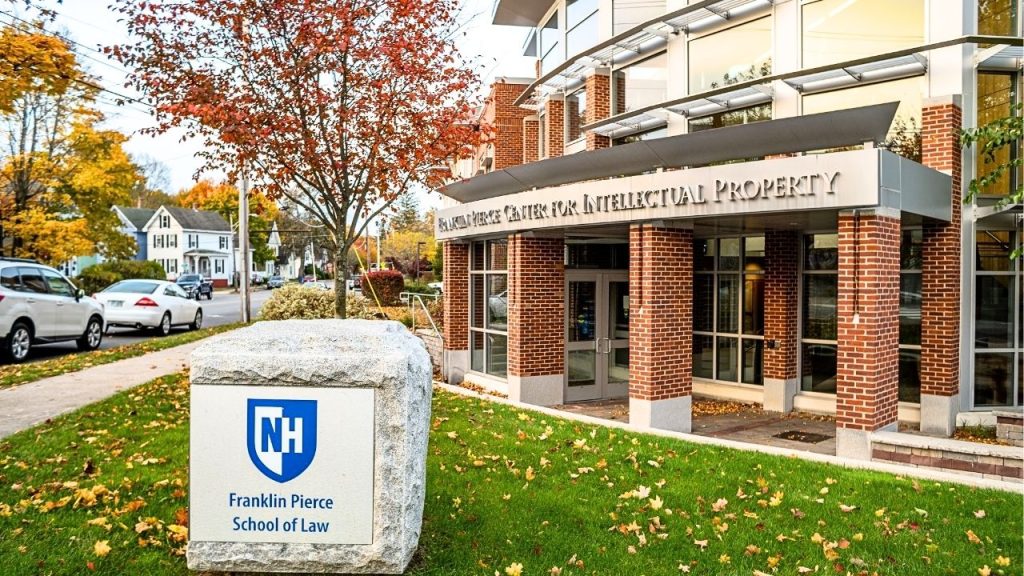
If you’re researching the Franklin Pierce Law School acceptance rate, you’re likely evaluating a program now formally known as UNH Franklin Pierce School of Law, part of the University of New Hampshire. This guide breaks down admissions stats, LSAT and GPA benchmarks, and practical strategies to strengthen your application.
Overview of This Law School
Originally founded as the independent Franklin Pierce Law Center in Concord, New Hampshire, the school merged with the University of New Hampshire in 2010. It’s widely respected for its intellectual property law program, one of the oldest and most established IP curricula in the country, alongside strong offerings in general practice, environmental law, and public interest work.
As a mid-sized law school, UNH Franklin Pierce tends to be more accessible than large national programs while still offering competitive academic training and strong bar passage support.
Admitted Students’ Score Range
LSAT Scores
Recent admitted classes at UNH Franklin Pierce have typically shown a median LSAT in the low-to-mid 150s, with the middle 50% range generally spanning roughly 149 to 155. Applicants scoring above this range are generally strong candidates for acceptance and merit scholarships.
GPA Scores
The median undergraduate GPA for recently admitted classes has generally fallen between 3.2 and 3.5, with the middle 50% range roughly spanning 3.0 to 3.6. GPA trends can shift year to year based on applicant pool strength.
Class Size and Acceptance Rate
Applicant Pool and Enrollment
UNH Franklin Pierce typically receives a moderate applicant pool compared to larger law schools, with incoming class sizes generally ranging from 100 to 150 students in recent cycles.
Acceptance Rate Trends
Based on recent admissions cycles, the acceptance rate has generally ranged between 40% and 65%, making it a moderately accessible option compared to highly selective national law schools. This means competitive applicants with LSAT and GPA scores near or above the median have a reasonably strong chance of admission.
How to Increase Your Chances of Acceptance
LSAT Prep Strategy
Aim to score at or above the median LSAT through structured prep, ideally 2 to 3 months of consistent study using official LSAC practice tests. Focus on timed practice and reviewing missed questions rather than just completing volume.
Personal Statement Advice
Write a focused, specific statement that explains why you want to practice law and, if relevant, why intellectual property or a related specialty interests you. Avoid generic statements. Admissions committees respond to authenticity and clear motivation.
Letters of Recommendation
Choose recommenders who know your academic or professional work well, ideally a professor or supervisor who can speak to your analytical skills, writing ability, and work ethic. Avoid letters from family friends or people without direct working knowledge of you.
Work Experience
Relevant experience, whether in legal internships, research, or a related professional field, can strengthen an application, especially for applicants with lower GPAs. It shows commitment and real-world readiness for law school demands.
Application Timing
Apply early in the cycle, ideally between September and December, since rolling admissions can mean later applicants face fewer available seats and less scholarship funding.
Final Thoughts / Quick Summary
UNH Franklin Pierce School of Law offers a strong niche reputation, particularly in IP law, with an acceptance rate that is moderately competitive rather than highly restrictive. Applicants with LSAT scores in the low-to-mid 150s and GPAs around 3.2 to 3.5 are generally well positioned, especially with a strong personal statement and solid recommendations.
Disclaimer: Admissions statistics, including acceptance rates, LSAT scores, and GPA figures, vary from year to year based on applicant pool and institutional policy changes. Readers should confirm current figures directly on the University of New Hampshire Franklin Pierce School of Law’s official admissions page before making application decisions.