
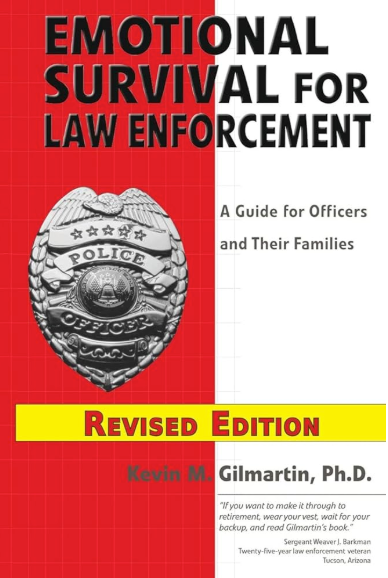
The emotional survival for law enforcement book by Dr. Kevin Gilmartin is not just a read. It might be the book that saves your career, your marriage, and your life.
Here is a number that should stop you cold: suicide claims nearly three times as many officers as line-of-duty deaths. And 83% of officers report experiencing mental health challenges during their careers. Yet most police training still spends more time on shooting accuracy than on what happens inside an officer’s head after years on the job.
That is exactly the gap this book fills.
What Is the Emotional Survival for Law Enforcement Book?
Written by behavioral scientist and former police officer Dr. Kevin Gilmartin, Ph.D., this book is a straight-talking guide built for officers and their families. Dr. Gilmartin spent over 20 years in law enforcement before dedicating his career to police officer emotional wellness. He knows this life from the inside. That is what makes this book different from a generic self-help manual.
It does not sugarcoat the job. It explains, with real science, why good cops slowly fall apart and what you can do to stop it.
The Hypervigilance Trap That Nobody Warns You About

One of the most powerful ideas in the book is what hypervigilance is in law enforcement. Dr. Gilmartin describes it as a heightened state of sensory sensitivity that officers must maintain on duty to stay safe. Your heart rate spikes. Your senses sharpen. Your body goes into full alert mode.
But here is the problem. When you come home, your body crashes hard. You feel exhausted, flat, and emotionally checked out. Dr. Gilmartin calls this the “hypervigilance biological rollercoaster”. You go from full combat mode at work to collapsing in a chair at home, mentally absent from your family. He even has a name for that chair. He calls it the magic chair. Sound familiar?
This is not a weakness. It is biology. And once you understand it, you can fight it.
The “I Usta” Syndrome and Why It Destroys Officers
Before the badge, you probably had hobbies, relationships, and a full identity. Maybe you coached your kid’s team, fished on weekends, or trained at the gym. After a few years on the job, many officers describe themselves with one word: cop.
Dr. Gilmartin calls this the “I usta” syndrome. Officers lose the other parts of their identity. They “used to” do this and that. The job takes over everything.
This matters because when the job is your only identity, every bad shift feels like a personal failure. Research confirms this is a driver of police officer cynicism and job burnout. When your whole sense of self is tied to one role, burnout does not just hurt your performance. It hollows you out as a person.
The Real Cost: Your Family Pays Too
Cop family stress and relationship problems are not talked about enough. But the numbers are brutal. A study of 3,994 officers found that 44% experienced psychological distress in the prior four weeks alone. When you are emotionally drained at home, your partner and kids absorb the impact.
This is why the book is subtitled “A Guide for Officers and Their Families.” It is not just written for the officer in uniform. It is written for the person waiting at home, wondering why their partner has changed.
If you are exploring reading that can genuinely shift your perspective on career and identity, check out this list of books to read before law school that also covers professional resilience and the mental demands of high-stakes careers.
How to Become an Emotional Survivor
The best part of the book is not the diagnosis. It is the prescription. Dr. Gilmartin outlines practical steps every officer can take:
- Practice goal-setting and time management outside of work
- Commit to regular physical fitness to lift you out of the parasympathetic crash
- Protect your financial well-being to reduce off-duty stress
- Build and maintain multiple roles in your life beyond being a cop
These are not complicated strategies. They are intentional habits that keep you anchored when the job tries to consume everything.
Who Should Read This Book Right Now
If you are a recruit, read this before your first shift. If you are a veteran officer wondering why you feel nothing anymore, this is the book that will explain your last ten years. If you are the spouse of an officer, this first responder mental health book will finally help you understand what is happening to the person you love.
Research shows 80% of officers report chronic stress affecting their overall well-being. That is not a coincidence. That is a system-wide problem. And this law enforcement wellness book is one of the clearest, most honest answers to that problem that exists in print.
Frequently Asked Questions
What is the emotional survival for law enforcement book about?
It is a guide by Dr. Kevin Gilmartin that explains the psychological and emotional changes police officers go through during their careers. It covers hypervigilance, burnout, identity loss, and practical steps to protect your mental health.
Who wrote the Emotional Survival for Law Enforcement book?
Dr. Kevin Gilmartin, Ph.D., a behavioral scientist with over 20 years of experience in law enforcement, PTSD, and mental health research. He is a former law enforcement officer himself.
Is the emotional survival for law enforcement book good for beginners?
Yes. It is written in plain language and is one of the best books for law enforcement officers’ mental health, recommended for recruits, veterans, and family members alike.
Does the book help with police officer burnout?
Absolutely. It directly addresses books for police officer stress and burnout, offering a biological and psychological explanation for why burnout happens and specific habits to prevent it.
Where can I buy the Emotional Survival for Law Enforcement book?
You can find it on Amazon and most major book retailers. Search emotional survival for law enforcement book Amazon for the most current edition.