
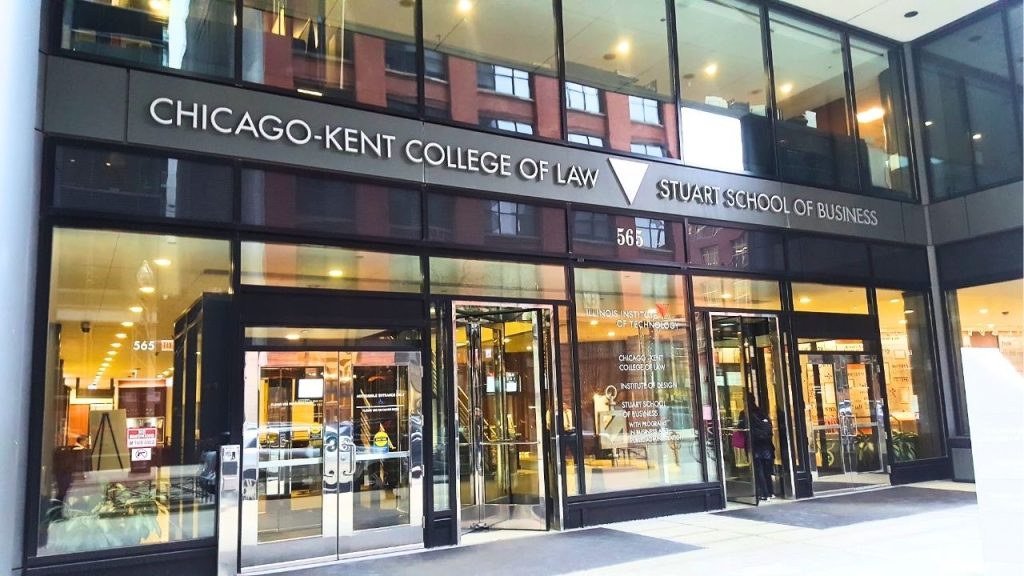
If you’re researching the Chicago-Kent Law School acceptance rate as part of your law school shortlist, you’re likely trying to gauge how competitive admission really is. Chicago-Kent College of Law, part of Illinois Institute of Technology, is a well-established Chicago law school known for strong legal writing training, trial advocacy, and IP law programs. This guide breaks down acceptance rate trends, GPA scores, LSAT ranges, and practical steps to strengthen your application.
Overview of This Law School
Chicago-Kent College of Law sits in downtown Chicago, giving students direct access to federal courts, major law firms, and a dense legal job market. The school is ABA-accredited and has built a national reputation in intellectual property law, along with respected programs in litigation, tax, and environmental law. Class sizes are moderate, which allows for closer faculty interaction than many larger law schools offer.
Admitted Students’ Score Range
LSAT Scores
Based on the most recently available admissions cycle data, admitted students at Chicago-Kent typically post a median LSAT score in the mid-150s, with the 25th to 75th percentile range spanning roughly the low-150s to upper-150s. Some competitive applicants with strong overall files are admitted slightly outside this range.
GPA Scores
The median undergraduate GPA for recently admitted classes has hovered around 3.5, with the middle 50 percent range falling between approximately 3.2 and 3.7. Applicants with GPAs on the lower end can still be competitive if their LSAT score, work experience, or personal statement are strong.
Note that exact figures shift each cycle, so treat these as directional benchmarks rather than fixed cutoffs.
Class Size and Acceptance Rate
Chicago-Kent generally receives a few thousand applications per cycle and enrolls an incoming class in the range of 150 to 200 students. Based on recent cycles, the overall acceptance rate has landed somewhere in the 40 to 50 percent range, making it a moderately selective school compared to top-14 programs, but still one where a well-prepared application matters.
Because law school admissions data changes year to year, applicants should treat these numbers as a general benchmark rather than a guarantee.
How to Increase Your Chances of Acceptance
Build an LSAT Prep Strategy Early
Start LSAT prep at least three to four months before your target test date. Use timed practice tests to identify weak sections, and prioritize logical reasoning and reading comprehension, since these sections carry the most questions.
Write a Personal Statement That Shows, Not Tells
Avoid generic statements about “wanting to help people.” Instead, use a specific story or experience that demonstrates judgment, resilience, or analytical thinking. Tie it back to why Chicago-Kent specifically fits your goals.
Choose Strong Letters of Recommendation
Ask professors or supervisors who can speak to your writing, analytical skills, or work ethic in detail. A specific, detailed letter from someone who knows you well outweighs a vague letter from a prestigious name.
Leverage Work Experience
Full-time work experience, especially in legal, research, or client-facing roles, can strengthen a borderline application. It signals maturity and gives admissions committees more to evaluate beyond grades and test scores.
Apply Early in the Cycle
Law schools often admit on a rolling basis. Submitting your application in the fall, rather than closer to spring deadlines, generally improves your odds since more seats and scholarship funds are still available.
Final Thoughts / Quick Summary
Chicago-Kent Law School offers a solid path into the legal profession, particularly for students interested in Chicago’s legal market or intellectual property law.
Recent cycles suggest a median LSAT in the mid-150s, a median GPA near 3.5, and an acceptance rate in the 40 to 50 percent range. A strong personal statement, thoughtful letters of recommendation, and early application timing can meaningfully improve your chances.
Disclaimer: Admissions statistics, including acceptance rate, LSAT, and GPA figures, vary from year to year. Readers should confirm current numbers directly on Chicago-Kent College of Law’s official admissions page before making application decisions.